Skin in the Game: What Makes a Chinese Game Character Feel Real?
Ask anyone to name a Chinese video game character, and chances are they will say Chun-Li. That is both her achievement and the problem.
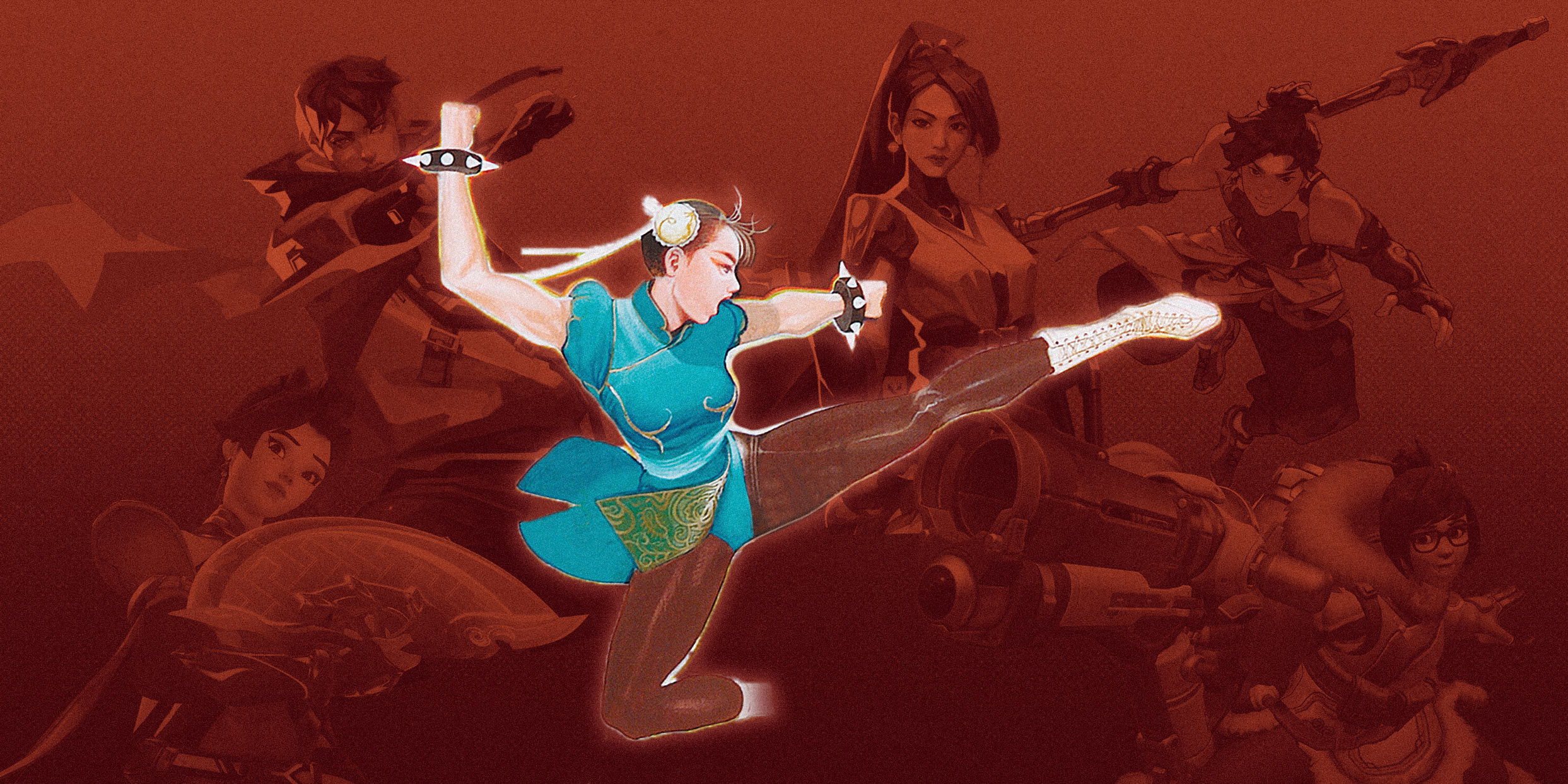
When Japanese gaming giant Capcom debuted her character in the 1991 arcade game Street Fighter II, Chun-Li was an Interpol officer. But it was her blue qipao, double buns, and devastating kicks that made her famous.
Those details made Chun-Li instantly recognizable, but they also turned her Chinese identity into spectacle — graceful, formidable, and framed for the male gaze. Her image was already so familiar by 1993 that Jackie Chan could parody her in his film “City Hunter” without explanation.
The arcade era rewarded that kind of instant legibility. Fighting-game characters were built from bold silhouettes, familiar archetypes, and minimal backstory. In Japanese developer SNK’s 1994 arcade fighting game The King of Fighters ’94, Chin Gentsai was the drunken, disheveled old man cast as the quintessential kung fu master. Chinese culture was visible, but largely reduced to type: exotic, recognizable, and stripped of psychological depth.
It would take another generation of games for Chinese characters to move beyond such tropes. By the mid-2010s, globally popular multiplayer titles were reaching vast Chinese audiences, whose size and commercial importance made their expectations harder to ignore. As Chinese characters became more common, players increasingly expected them to feel culturally grounded rather than assembled from stock signs.
When American video game developer Blizzard released the first-person shooter Overwatch in 2016, its Chinese hero, Mei-Ling Zhou, seemed to mark a step beyond the old archetypes. A climatologist from Xi’an in northwestern China, Mei wears polar expedition gear and is portrayed as affable, resilient, and determined to protect both people and the planet.
Yet while Mei is more fully drawn than the arcade characters before her, her Chinese identity remains largely incidental. Her nationality adds diversity to Overwatch’s global cast without meaningfully shaping her inner life.
Nearly a decade later, Overwatch introduced its second Chinese hero, Wuyang Ye. A 19-year-old from the southwestern Sichuan province, he attends the fictional Wuxing University, whose colleges draw on the five traditional Chinese elements. Yet the most revealing detail is also the most ordinary: Wuyang is a college student, a figure immediately familiar to much of the game’s Chinese audience.
Overwatch also gave its characters linguistic markers of where they came from. In the English-language version, an allied Mei shouts “Freeze, don’t move!” when using her ultimate ability; an enemy Mei delivers the warning in Mandarin. For Chinese players, the switch allowed her nationality to be heard rather than merely listed in her biography.
By the time Wuyang appeared, simply hearing a Chinese character speak Chinese was no longer enough. In a 2025 promotional trailer, he dismisses a challenge with “xiao case,” a Chinese-English expression roughly equivalent to “piece of cake.” Some Chinese viewers found the line playful; others argued that a student from Sichuan should instead use the local expression “le ge hao long” — “this one’s easy.”
The disagreement was minor, but it showed how expectations had changed. Players expected his language to reflect where he came from and who he was.
In 2026, Wuyang’s elder sister, Anran Ye, joined the Overwatch roster. Associated with the element of fire, she is forceful, impatient, and quick to challenge her younger brother. Their exchanges introduce sibling rivalry, parental pressure, and family expectations, giving both characters a social world beyond their individual backstories.
This marks the clearest break from Mei. Mei’s Chinese identity is conveyed largely through nationality and language; the Ye siblings’ emerges through family relationships and everyday behavior. Anran feels familiar not as a symbol of China but as the demanding older sister who refuses to let her younger brother coast.
The 2020 tactical shooter Valorant, developed by U.S. video game company Riot Games — owned by Chinese tech giant Tencent — offers a different kind of Chinese character. Sage is built around protection rather than aggression: she heals injured teammates, raises defensive barriers, and can revive fallen allies. Players often call her “mom,” a playful nickname rooted less in her nationality than in the trust inspired by her abilities and calm authority.
Three years later, Valorant introduced its second Chinese character, Iso, a hired gun from the southwestern megacity of Chongqing. His abilities are built around single combat, allowing him to isolate opponents and force them into one-on-one fights. The contrast with Sage is immediate: Sage protects and restores her team, while Iso is aggressive, self-contained, and designed to fight alone.
Iso’s reveal trailer featured “Renegade,” an original track by Chinese rappers 99 God and C103, grounding the character in contemporary Chinese music without relying on traditional costume or martial-arts imagery.
Neither character is expected to represent China as a whole or reduced to a single cultural type. Together with Mei, Wuyang, and Anran, they mark a broader shift in global competitive games, where Chinese characters increasingly appear as individuals rather than national symbols.
Chinese culture has also become more visible beyond character rosters. In League of Legends, developed by Riot Games, and Honor of Kings, developed in China by Tencent’s TiMi Studio Group, players can buy skins inspired by Chinese mythology, clothing, and decorative motifs.
But visibility alone was not enough. Anran’s trailer presented her as fierce and commanding, while her in-game model appeared cuter and more delicate.
Chinese players objected to the mismatch, and Blizzard later announced changes to the design. The response showed that players were judging not merely whether Chinese elements were present but whether the character remained consistent with the world and personality the game had established.
From Chun-Li to the Ye siblings, and from Sage to Iso, Chinese characters in global competitive games have begun to move from spectacle to self. They are no longer recognized only through costume, accent, or archetype. Players now debate how they speak, how they look, where they come from, and whether those details add up to a convincing person.
In the years ahead, perhaps the misty canal towns of Jiangnan, in eastern China’s lower Yangtze region, will appear on a new arena map, Miao embroidery on a tournament skin, or Tang dynasty poetry woven into a champion’s identity. But such details will matter only when they do more than decorate.
When culture is lived rather than labeled, a Chinese figure stops being a symbol. They become someone players can root for, and perhaps someone who brings them closer to their own roots.
(Header image: Visuals from Street Fighter, Blizzard, and Riot Game, reedited by Sixth Tone)